Section 01The continent serves noodles in a thousand shapes — here is how to read what is in the bowl before you eat it
Flour, Water, Region: The Logic Behind the Noodle
The noodle map of Asia follows the grain map almost exactly. Wheat grows across the north and west — China's interior, Japan, Korea, Central Asia — and the noodles there are dense, elastic and built to carry weight. Rice dominates the tropical south and east, and rice noodles are correspondingly lighter, paler and faster to cook. Between those two geographies, in the hill country of northern mainland Southeast Asia and across parts of South Asia, a handful of older ingredients — buckwheat, mung bean starch, tapioca — fill the gaps, producing noodles that behave differently from either.
That is the skeleton. The flesh is considerably more interesting.
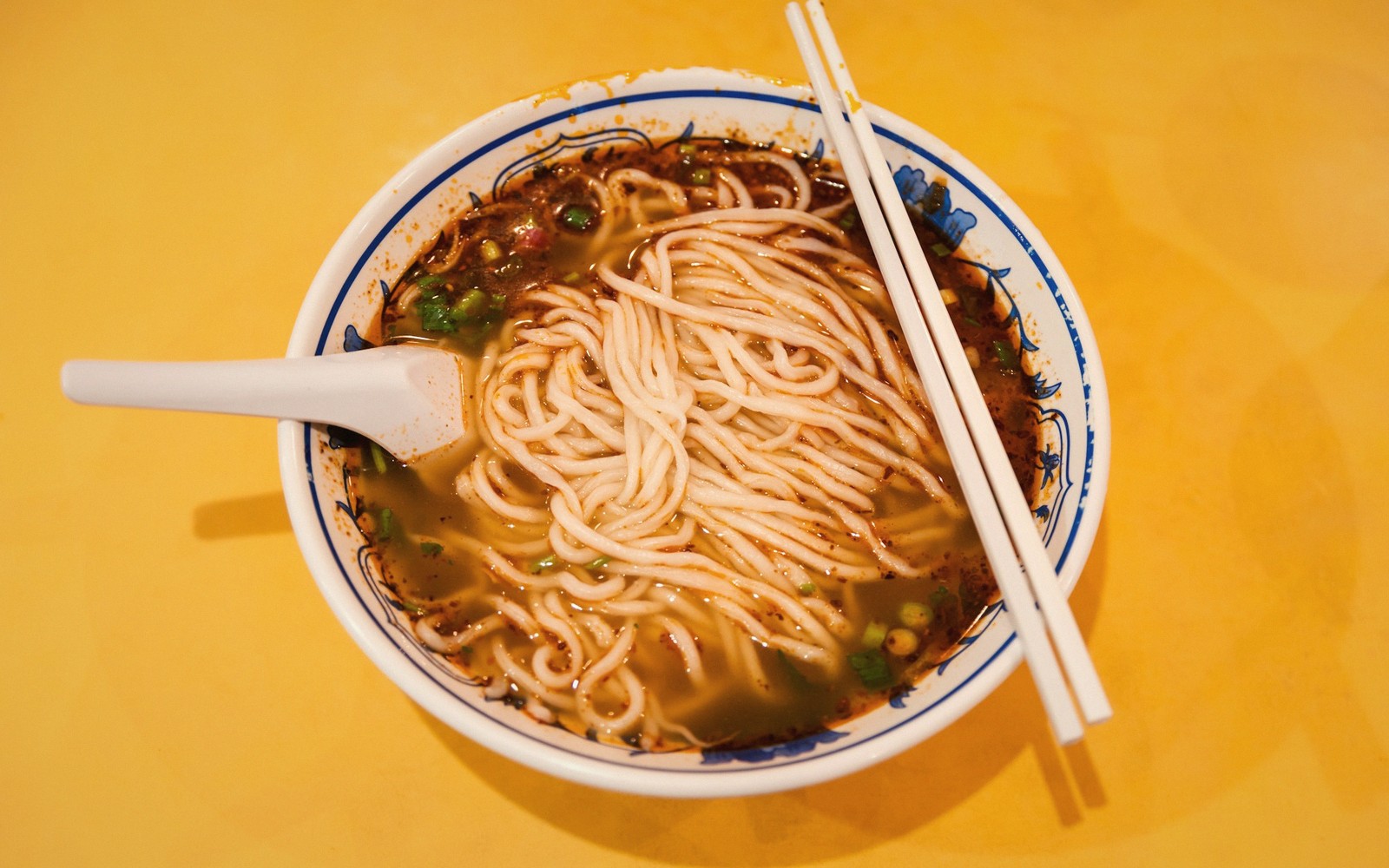
Wheat noodles divide first by process. Chinese la mian — hand-pulled noodles — are made by stretching and folding a single length of dough until it divides into dozens of strands. The technique takes years to master and the product has a particular chew, springy and slightly uneven, that machine-made noodles cannot replicate. You will find pulled noodles at their most dramatic in the Muslim-majority restaurants of Lanzhou-style kitchens, now scattered across Chinese cities, and in the Uyghur cooking of Xinjiang, where the same thick, hand-stretched noodle appears in a wok-tossed dish called laghman — a word that shares a root with la mian, evidence of the old Silk Road traffic. Further west still, in the teahouses of Samarkand and Bukhara, noodles appear in soups and pilafs as a trace of the same lineage.
Japanese wheat noodles split into three distinct personalities. Udon is the widest and most forgiving — soft, pale, and at home in a simple dashi broth or under a mound of tempura. Ramen is the most complex: an alkaline wheat noodle, made with kansui water to give it that characteristic yellow tint and firm bite, served in a broth that can take eight hours to produce and varies enormously by region. Sapporo's is rich with miso and butter; Hakata's is a cloudy tonkotsu pork bone; Tokyo's is clear, clean and soy-seasoned. Then there is somen: hair-thin wheat noodles, eaten cold in summer, draped over ice and dipped into a light tsuyu. Three noodles, three completely different experiences, all from wheat.
Buckwheat noodles occupy a cooler register. Japanese soba — the most widely known — is typically a blend of buckwheat and wheat flour (the all-buckwheat juwari soba is rarer and more fragile), served cold on a bamboo rack with a dipping sauce or hot in a broth. In the mountains of Nepal and northern India, a closely related grain, phapar, appears in rustic preparations. Korean naengmyeon uses buckwheat alongside potato starch to produce a particularly elastic, almost slippery noodle, served ice-cold in a vinegared beef broth with a hard-boiled egg — a summer dish that refreshes through sheer temperature contrast.
Rice, Mung Bean and the Noodles of the Tropical South
Rice noodles are not one thing. They are a family with distinct members, and knowing which is which changes what you order.
Bánh phở, the flat rice noodle of Vietnamese phở, is cut into ribbons roughly a centimetre wide and has a gentle, slightly silky surface that soaks up broth without disintegrating. Order phở in Hanoi and the bowl is leaner than the south Vietnamese version — less sweet, less garnished. The noodle itself is the same; the broth does the regional talking. In the same country, bún is a round rice vermicelli, thinner and firmer, which appears in bún bò Huế (a spicier, less famous cousin of phở), in cold noodle salad bowls, and as the base for the dry-assembled dishes of the central coast around Hoi An.
Thailand's rice noodle vocabulary is equally specific. Sen lek (small noodle) is the flat rice ribbon used in pad thai and most noodle soups; sen yai (big noodle) is wide, almost like a fresh pasta sheet, and appears in the stir-fried pad see ew. Rice vermicelli (sen mee) is finer still, used in light soups and fresh spring rolls. The names translate literally and the market vendors in Bangkok or Chiang Mai will understand if you use them — they are not technical jargon but the everyday vocabulary of the kitchen.
In Laos and parts of northern Thailand, sticky rice dominates as the staple, but the noodle of Luang Prabang and the surrounding highlands is often khao piak sen, a thick, fresh rice noodle with a particularly gelatinous body that is somewhere between a noodle and a dumpling in texture. It is a morning dish, served in chicken broth, and it is worth getting up early for.
Cambodia has num banh chok, fresh fermented rice noodles served cold at dawn with a green fish curry sauce poured over the top. The fermentation gives them a faint sour note that distinguishes them from any other rice noodle on the continent. It is one of the more unusual breakfasts in Southeast Asia.
Glass noodles and starch noodles form a third category that does not fit neatly under either wheat or rice. Dangmyeon, the Korean sweet potato starch noodle used in japchae, is grey when dry, translucent and chewy when cooked, and has a capacity to absorb sauces without breaking down. Chinese fen si (mung bean thread, or glass noodle) is nearly invisible in a clear broth, soaks up flavour aggressively and is used across Chinese, Thai, Vietnamese and Lao cooking — often stuffed into spring rolls or added to braised dishes where it functions as a flavour sponge. In parts of South Asia, particularly in the street food of Kolkata, mung bean vermicelli turns up as a filling, a texture, a side.
How to Read the Bowl
A few practical signals help identify what you are looking at before the first bite. White noodles in a Southeast Asian context are almost always rice; yellow noodles in an East Asian context are likely wheat with kansui; grey or brown implies buckwheat or a starch blend. Translucent noodles are starch-based. Flat and wide usually means rice in the tropics, wheat in colder climates.
Texture tells you more than appearance. A springy, elastic bite — one that resists and then releases — almost always means wheat gluten is at work. A soft, yielding bite that soaks up liquid means rice or starch. That slightly gelatinous, gluey chew is the signature of pure starch noodles: sweet potato, mung bean, tapioca.
Broth and dressing amplify what the noodle already is. A light, clear broth shows off the delicacy of rice noodles without overwhelming them; a rich, heavy tonkotsu or a dark soy-braised sauce needs the tensile resistance of wheat to keep from turning everything to mush. The pairings are not arbitrary — they have been worked out over centuries. Follow them, and the bowl will make sense even before you can read the menu.
Wheat grows across the north and west — China's interior, Japan, Korea, Central Asia — and the noodles there are dense, elastic and built to carry weight.