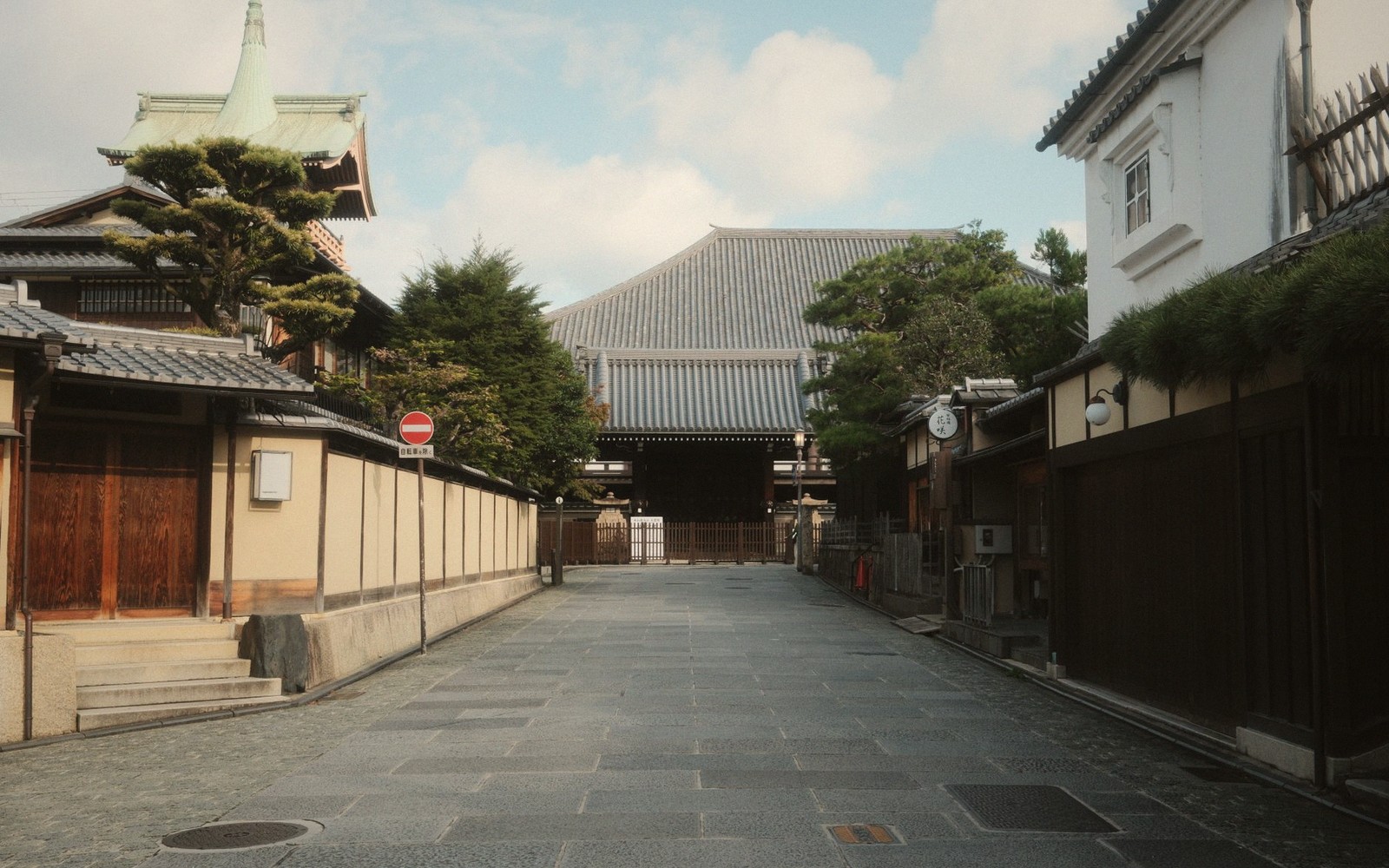
The City Is Smaller Than You Think
Kyoto sits in a flat basin ringed by forested hills, and it was laid out on a grid — the Heian-period planners borrowed the logic from Tang dynasty Chang'an. That geometry still reads on the ground. Major temples anchor the eastern hills, the old imperial estates fill the northwest, and the commercial and culinary core runs through the centre. What surprises first-time walkers is how manageable the distances are: the city is roughly eight kilometres from east to west at its widest navigable band. Bicycle or foot covers most of what matters, and the hills do the work of orientation.
The trap is the coach-tour circuit — Kinkaku-ji, Fushimi Inari, Arashiyama, ticked in sequence from a tour bus window. These are real places worth seeing, but the crowds at each are dense enough to flatten the experience. The antidote is neighbourhood walking: choosing one quadrant per day, arriving before the morning tour rush, and treating the streets between the temples as the actual destination.
Four Neighbourhoods Worth a Full Morning Each
Higashiyama. The long ridge of eastern Kyoto is where most visitors already go, but they tend to move in a single compressed stream up Ninenzaka and Sannenzaka — the famous stone-paved lanes — then filter into Kiyomizudera and leave. Walk instead from the Chion-in gate south through Maruyama Park and down into the Ninenzaka approach from below. The lanes between are lined with machiya — traditional Kyoto townhouses with their distinctive latticework facades — many still operating as shops, workshops or quiet guesthouses. Kodai-ji, a Momoyama-period Zen temple with exceptional dry gardens, sits just off the main flow and is rarely as crowded as its neighbour.
Fushimi. South of the city centre, Fushimi sits apart from the main tourist drag and repays the extra bus or train stop. The Fushimi Inari shrine — ten thousand vermilion torii gates climbing Mount Inari — is one of Japan's most photographed places, and the lower gates are always busy. The solution is vertical: the full circuit to the summit and back takes two to three hours, and the crowds thin rapidly above the first ridge. Come early and keep climbing.
Nishiki and the central machiya streets. Nishiki Market, a covered street just north of Shijo, is Kyoto's working food market — pickled vegetables, tofu varieties in shapes you won't recognise, skewered street food sold from narrow stalls to a shoulder-to-shoulder crowd. It is genuinely good and genuinely local. More interesting for walkers is the grid of streets between Nishiki and Oike: pocket shrines in tiny walled courtyards, incense wholesalers, lacquerware ateliers, the occasional machiya front that has barely changed in a century. None of this is hidden; it just requires walking rather than riding.
Arashiyama and Sagano. The bamboo grove at Arashiyama appears in every itinerary. It is spectacular for about thirty seconds before the selfie queue breaks the spell. Walk fifteen minutes north into Sagano instead. The narrow lanes pass rice plots, thatched farmhouses, small temples that draw almost nobody — Jojakko-ji, climbing steeply into the cedar hillside, is one of the finest and least-visited temple gardens in the city. The approach takes you past Nison-in and Gioji, a moss garden so quiet it feels accidental. Arashiyama is still worth the tram ride; just keep walking past the bamboo.
What the Slow Radius Actually Teaches
Kyoto's depth is architectural. The city holds some seventeen hundred Buddhist temples and Shinto shrines, a figure so large it becomes meaningless until you start noticing the small ones — the neighbourhood shrine with a single ginkgo tree, the sub-temple tucked inside a larger complex where the head priest is raking gravel at seven in the morning. These places are not on the highlight reel. They are accessible only if you are walking and you are not in a hurry.
The machiya deserve a separate mention because they are rapidly disappearing to redevelopment, which makes the remaining concentrations — particularly around Nishiki, the Gion district, and the streets approaching Nijo Castle — worth treating with some attention. The proportions of a good machiya are worth pausing for: the narrow street facade concealing a long interior that opens to a courtyard garden midway through. Several have been converted into restaurants or small hotels, and an evening meal in a machiya interior is one of the better ways to understand why Kyoto's urban fabric matters beyond its monuments.
Practicalities are straightforward. Buses cover the main corridors and IC cards (Suica and ICOCA work city-wide) handle payment without exact change. For the eastern hills and Arashiyama, a bicycle rental from one of the central shops near Kyoto Station gives more flexibility than the bus routes without adding car noise. Shoes matter: the stone lanes of Higashiyama are uneven, and Inari is a mountain.
The best time is spring — cherry blossom, and the brief window when the gardens are at full tilt — or autumn, when the maple canopy over the hill temples turns properly red. Both seasons are busy. The recompense is that Kyoto in full foliage is one of the genuinely beautiful sights of East Asia, and some things are crowded because they are worth it.
Kyoto sits in a flat basin ringed by forested hills, and it was laid out on a grid — the Heian-period planners borrowed the logic from Tang dynasty Chang'an.