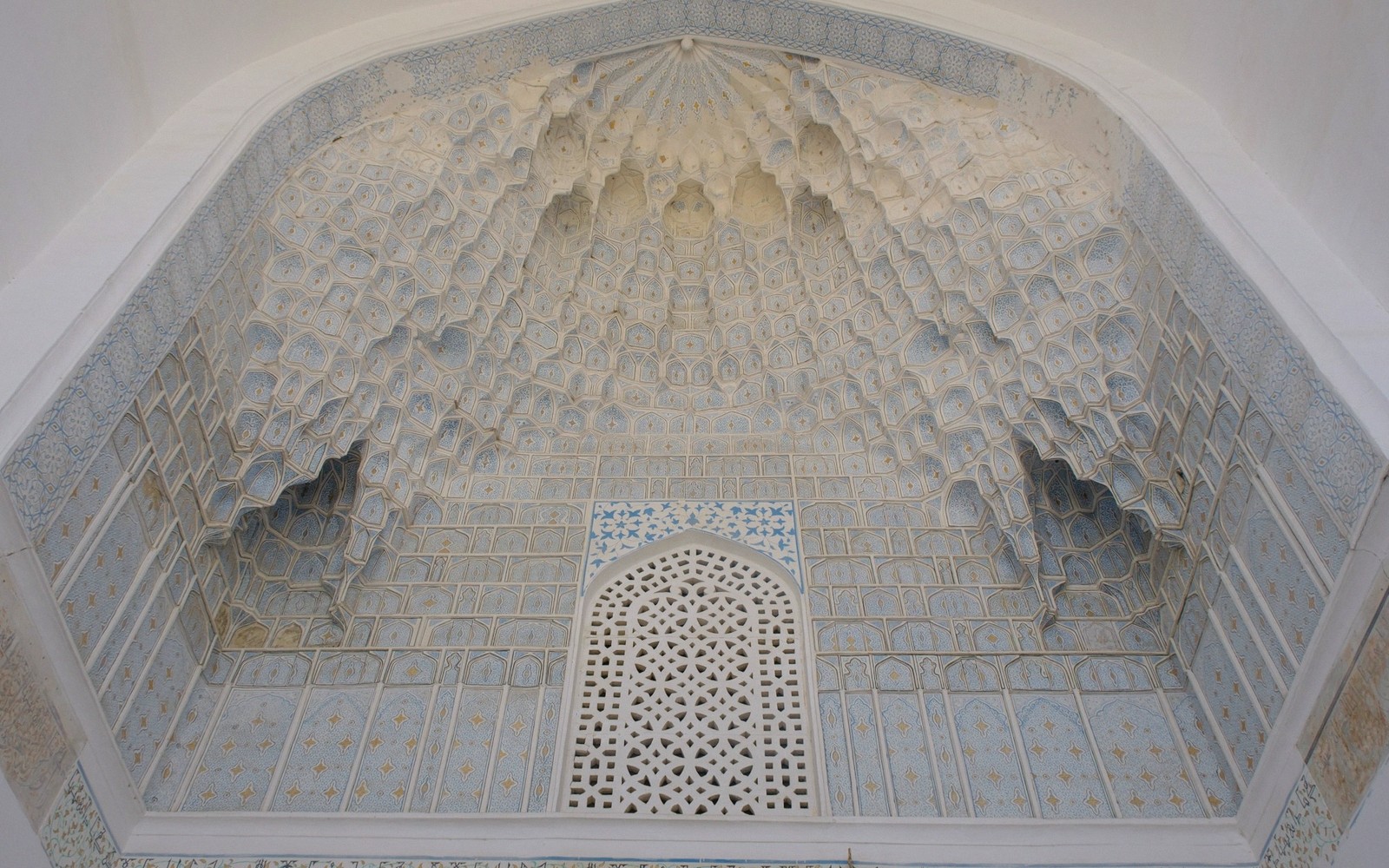
Section 01What You Are Actually Looking At
The names arrive loaded with mythology, and the cities do not disappoint — not exactly. Samarkand, Bukhara, Khiva: three Uzbek cities strung across the ancient trade corridors between China, Persia and the Mediterranean, each now a UNESCO World Heritage site, each in varying states of restoration, and each requiring a small act of historical calibration before the full picture comes into focus.
The honest framing is this: much of what you see has been rebuilt, sometimes substantially, and most of the rebuilding happened in two distinct waves — first under the Soviet Union, which restored major monuments with genuine scholarly intent but also a taste for the emphatic, and again more recently under the Uzbek state, which has poured money into heritage tourism with results that range from impressive to disconcerting. None of this makes the cities less worth visiting. It makes them more interesting, because once you know the difference between original fifteenth-century tilework and a twentieth-century replacement panel, you begin to read the buildings in a completely different way. The originals glow with a quality no restoration has quite matched: that slightly irregular, mineral-deep colour that comes from centuries of compressed light.
The order of difficulty, broadly, runs from Samarkand (most visited, most infrastructurally comfortable) through Bukhara (the best preserved old city fabric) to Khiva (most remote, most fully museumified). All three reward slow walking and some prior reading.
Section 02Samarkand: The Monumental Core
Samarkand was already an ancient settlement when Alexander of Macedon passed through in the fourth century BCE. Its peak came later, under Timur — Tamerlane — who made it the capital of his empire in the late fourteenth century and dragged architects, craftsmen and scholars from across conquered territories to adorn it. The bones of that Timurid city remain, even if the flesh has been substantially renewed.
The Registan is the centrepiece: three madrassahs arranged around a central square, their facades covered in muqarnas, geometric tile panels and monumental Kufic script. The three buildings span the fifteenth and seventeenth centuries — Ulugh Beg's madrassah on the west is the oldest and named for Timur's grandson, the astronomer-sultan who built an observatory outside the city. The Sher-Dor madrassah opposite features lions and a human face above the arch, an unusual deviation in an artistic tradition that typically avoided figurative representation. Look carefully at the tilework across all three facades: the difference in patina between original sections and Soviet-era restorations is legible once you know to look. The originals have a matte depth; the replacements tend to read slightly flatter and brighter.
Gur-e-Amir, Timur's mausoleum, is a short walk from the Registan and arguably the more affecting building: its ribbed melon dome is covered in turquoise tiles that shift colour through the day, and the interior holds Timur's cenotaph in dark green jade alongside those of family members, including Ulugh Beg. The chamber is intimate compared to the exterior's grandeur, which is precisely the point — domes in Timurid architecture are designed to impress from a distance and then to humble at close range.
Outside the monumental core, the Shah-i-Zinda necropolis is where serious tile-reading becomes genuinely absorbing. A long avenue of mausoleums built between the eleventh and fifteenth centuries for court nobles and Timur's relatives, it is less touristically polished than the Registan and correspondingly more moving. The tile programmes here are extraordinarily varied: star patterns in cobalt and white, calligraphic bands in gold on turquoise, carved terracotta interspersed with glazed mosaic. Because the structures are smaller and less heavily restored, the original work survives in higher proportion. This is where you slow down.
Samarkand was already an ancient settlement when Alexander of Macedon passed through in the fourth century BCE.

Section 03Bukhara: The Old City That Still Functions
Bukhara's claim on attention is different from Samarkand's. Where Samarkand offers concentrated monuments amid a modern city, Bukhara has a functioning old city — a warren of low mud-brick streets, covered bazaars, teahouses and mosques that still feel inhabited rather than curated, even as tourism reshapes it. The Lyabi Hauz, a pool surrounded by mulberry trees and old buildings, is the social centre of gravity, and on summer evenings it still works as one: old men playing cards, families eating plov, the occasional chess game extending past dark.
The Kalon Minaret is the city's signature silhouette — a twelfth-century tower built under the Karakhanid dynasty, so tall and so finely tapered that even Genghis Khan, who sacked Bukhara in 1220 and destroyed much of it, reportedly spared it. The story may be apocryphal, but the minaret's survival across eight centuries of invasion, earthquake and political upheaval is real enough. The brick patterning on its shaft — different geometric registers stacked vertically, each section distinct — is a complete education in pre-tile-era Islamic architecture: what the medium of unfired and fired brick alone could do.
The Ark, a massive fortified citadel on the western edge of the old city, represents Bukhara's longevity as a seat of power from ancient times through the emirate that survived, in nominal form, until the Soviet takeover of 1920. Its interior is partly a museum and partly a ruin — whole sections collapsed or were destroyed during the Soviet assault — but the scale of the thing, and the view from the rampart wall over the old city, is worth the climb. The Museum of History inside holds material on the emirate period, including court costumes and diplomatic correspondence, that gives context the monuments alone cannot.
The Samanid Mausoleum, predating almost everything else in the city, is easy to miss on the map but essential. Built in the early tenth century for the founders of the Samanid dynasty, it sits in a park slightly apart from the main heritage cluster. It is the oldest surviving Islamic monument in Central Asia and one of the finest: the brickwork is arranged in patterns that change appearance depending on the angle and intensity of light — a decorative system of pure geometry, no glaze, no colour, just the logic of brick. Stand at different distances and watch the facade's texture shift. Nothing in Bukhara is more quietly extraordinary.
Section 04Khiva: The Open-Air City
Khiva is the furthest from anywhere — roughly ten hours overland from Bukhara, or reachable by a short flight from Urgench — and the most visually coherent of the three cities. The Ichan Kala, the inner walled city, has been so thoroughly preserved and restored that it functions essentially as a living museum: almost every building within the walls is a heritage site, entrance fees accumulate quickly, and the residential population has largely been displaced. That last fact gives Khiva a slightly sealed, diorama-like quality that Bukhara, for all its tourism, avoids.
The visual signature of Khiva is the Kalta Minor minaret: unfinished, stumpy, covered entirely in turquoise and white tilework, begun in the mid-nineteenth century under Mohammed Amin Khan, who intended it to be the tallest minaret in the world. He died before it reached a fraction of the intended height, and no subsequent ruler completed it. It stands now as the city's most recognisable image — a monument to interrupted ambition, which is, in some sense, a fitting emblem for the whole Silk Road project.
The tilework at Khiva is predominantly nineteenth century, which makes it easier to appreciate without calibration: the restorations here are largely replacing like with like from a relatively recent period. The Islam Khoja Minaret, slender and later than the Kalta Minor, offers a climb with views over the flat geometric pattern of the inner city's rooftops and beyond to the desert — the Kyzylkum to the east, the Karakum to the south. Central Asia, from that vantage, reasserts its actual nature: not a corridor of cities but a vast arid expanse in which those cities are improbable, precious, and hard-won.
Section 05Reading the Route
The three cities connect by a fast daytime train between Samarkand and Bukhara — a comfortable, well-used service — and then by road or air between Bukhara and Khiva. The Samarkand–Bukhara–Khiva sequence is the standard itinerary and flows logically west, deeper into history and further from the contemporary. Allow at least two full days per city; one is not enough to slow down into the neighbourhoods, the teahouses, the courtyards that open behind unremarkable doors, the moment when the tilework stops being decoration and starts being language.