Section 01The Shape of the Journey
The Mekong does not run in a straight line convenient for travellers. Rising in the Tibetan Plateau, it curves through Yunnan before forming the borders of Myanmar, Laos and Thailand, then cuts through Laos proper, edges Cambodia and finally fans into the delta south of Ho Chi Minh City. The classic overland route picks up the river somewhere in northern Laos and follows its logic south — not slavishly, because roads and the river diverge constantly, but using the water as the through-line that gives the journey its shape.
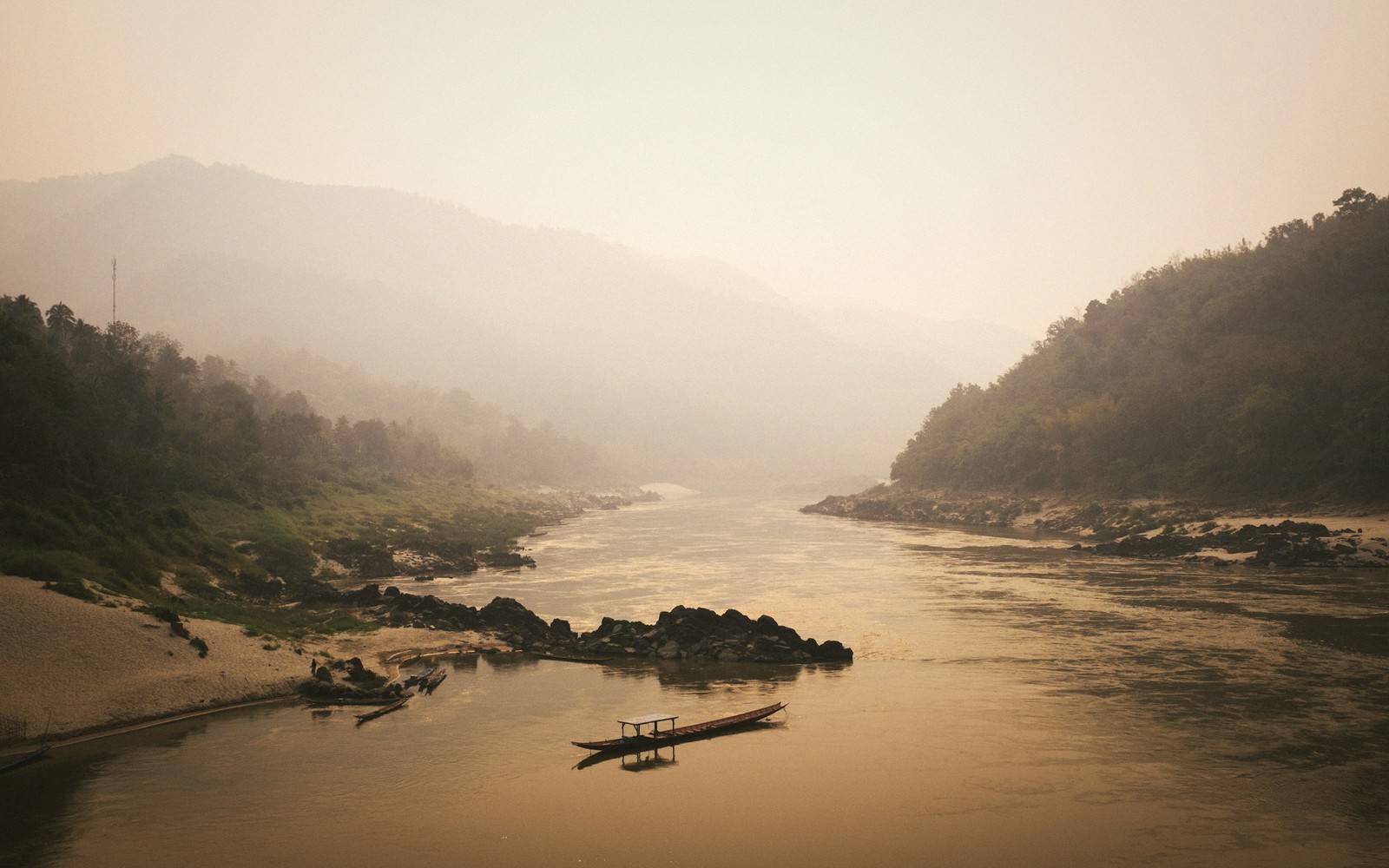
Most independent travellers enter the route at Huay Xai, a small Lao border town reachable by bridge from Chiang Rai in northern Thailand. The crossing is straightforward — Lao visa on arrival is available here — and from Huay Xai the slow boat departs downriver toward Luang Prabang. Two days on a wooden passenger boat, stopping at villages, watching the karst recede and reassemble: this is the portion of the route that travellers remember longest, not because it is comfortable (the benches are hard, the engine loud) but because the pace is honest. The alternative speedboat covers the same distance in a fraction of the time and is loud enough to require ear protection. Take the slow boat.
Section 02Where Patience Pays
Luang Prabang rewards stopping. The former royal capital sits on a peninsula between the Mekong and the Nam Khan, its streets lined with Franco-Lao shophouses and temple compounds. The morning alms-giving procession — monks filing through the streets at dawn to receive sticky rice — is one of Southeast Asia's genuinely affecting sights, though it has become touristy enough that watching from a respectful distance, rather than participating in the scrum, is the right call. A few days here, then south by bus along Route 13, which runs more or less parallel to the river through a sequence of provincial towns before reaching Vang Vieng and eventually Vientiane.
Vientiane is the quietest capital in Southeast Asia by some margin — more overgrown river town than metropolis — and its calm after the bus journey feels earned. The Mekong here forms the border with Thailand; on clear evenings the lights of Nong Khai glow across the water. Southward, the route continues by bus into the Bolaven Plateau region and the four-thousand-island archipelago of Si Phan Don, where the river widens dramatically and the pace slows again. Si Phan Don is the natural end of the Lao portion — small islands connected by bicycle tracks, hammocks, and the rare Irrawaddy river dolphin still occasionally spotted in the deeper channels near Khone Phapheng.
The crossing into Cambodia at the Don Kralor–Stung Treng border is the least glamorous moment of the journey: a tuk-tuk to the Lao frontier, a boat across to the Cambodian side, and then a long road south. But Stung Treng to Kratie rewards the effort. Kratie sits directly on the Mekong and is the best base for dolphin-watching; at dusk the light on the river here is extraordinary. From Kratie the road runs south to Phnom Penh, and the Mekong widens again into something enormous, joining the Tonlé Sap and losing its identity as a single navigable thread.
The former royal capital sits on a peninsula between the Mekong and the Nam Khan, its streets lined with Franco-Lao shophouses and temple compounds.
Section 03Reading the Route
The overland Mekong journey works best when treated as a series of slow stays rather than a transit to be completed. The towns that reward patience — Luang Prabang, Si Phan Don, Kratie — do so precisely because they sit at natural breaks in the river's rhythm, where the water changes speed or character and forces a recalibration. The towns that disappoint are the ones rushed through in a bid to cover ground.
Seasonally, the dry months between November and April suit the route best: roads are passable, river levels manageable, and the slow boat runs reliably. During the monsoon the river swells impressively but some roads become difficult and border crossings can be disrupted. The overnight train is not part of this route in the pure sense — Laos's rail link is limited — but connections by sleeper bus are common and function on the same logic: board in the evening, arrive somewhere new at dawn, and let the journey do the organising.